Chapter 38: Judging People

You can fool some of the people some of the time, but you can’t fool all of the people all of the time.
Bakari: Swahili — He Who Will Succeed
Rascal / Jester
Over the past few years I have reached out to people in my past. These are people whom I have not seen for decades. In the beginning my object was to give them thanks for being important in my life at the time or apologize for my actions years ago. It was quite interesting in that when giving thanks, they appreciated it. When apologizing, most did not remember the incident that caused the guilt I carried deep in my unconscious for years.
As I continued reaching out, I also asked what people thought of me decades ago. I remembered what I thought of myself and how I was presenting myself to the world. I wondered how the rest of the world viewed me.
Those conversations often left me wondering how accurately we ever know another person, or even ourselves.
Aunt Al
I call my mother’s best friend at times. Aunt Al (Alice) as we all knew her. My mother passed away in 1986, yet the bond between them will never change.
Aunt Al is 98, still lives on her own and when talking to her I can see her great smile while she laughs during our conversations. Every time I talk to her, she reminds me of the sailing lessons I gave her. And every time I talk to her she calls me a rascal. I don’t ever remember being referred to in that way when I was a kid, but I guess my personality fit the bill. In fact in my 60’s and 70’s, my mother-in-law, Zoe, and my brother Jim referred to me in the same way.
Our families both lived in the same town in northern NJ during the school year and lived down the street from Aunt Al and her family in the bay side of a beach town, Normandy Beach.
All the kids were brought up swimming, sailing small boats, water skiing and some of us surfing.
When I was about 16, my mother asked me if I would teach Aunt Al how to sail. I had sailed for about 8 years, first as a crew and by the time I was 12 I either took boats out on my own or with friends. In those days no one wore life jackets to go sailing unless we saw a storm approaching. I had never taught anyone to sail before, but I figured I could teach her and so I said, “Yes.” It was also virtually impossible to say no to my mother’s request.
In those days we first learned to sail flat sailboats called a Sailfish. It could be tipped over on its side and then brought upright by just standing on the centerboard which stuck out from the bottom of the boat.
So here we were, Aunt Al in her one-piece bathing suit and bathing cap and skinny me in my cutoff dungarees.
We pushed off in the warm summer water with a very light wind. I first took both the line to the sail and the tiller and slowly instructed her in how to pull the sail in based upon the wind direction and how to steer the boat. After about five minutes doing that, I gave her the line to the sail so she could have a feel for the force of the wind. She managed that quite nicely. We then changed places on the boat and she started steering as I held the line to the sail.
At that point the rascal in me took over. I jumped up from the sitting position, grabbed the mast of the boat and tipped the boat over to Aunt Al’s horror. I thought it was all quite funny, but that is what a 16-year-old rascal would think.
I then guided Aunt Al to the bottom of the boat where the centerboard stuck out and had her pull on it until the boat was brought upright.
At that point a bit exasperated, but laughing, she asked me what I did that for.
It was an easy answer.
“If you want to sail you have to know what to do if the boat tips over.”
Lesson number two started in much the same way. Aunt Al took the tiller and then the line to the sail so she was now single-handing the boat. She seemed a natural for sailing. As a pilot has their first solo, I felt she was ready for that. I jumped overboard and swam next to her while giving some basic instruction.
She was laughing but nervously asking me why I jumped overboard.
Again, it was an easy answer.
“You were ready to handle the boat on your own and I won’t let you sail away from me.”
As far as I remember that was the last lesson from the rascal, but she did learn to sail.
At my 50th college reunion, I hadn’t seen any of those friends in half a century. One of the first things someone said to me, after confirming I was still upright and had a drink in hand, was, “I remember visiting you at the shore and you tipped the boat over.”
Then others chimed in saying the same thing.
I had no memory of doing that to anyone other than Aunt Al. Maybe my nickname back then, Tequila Tom, had something to do with why those memories are a little hazy.
Dizzy (Diz)
I went to a small liberal arts college in Carlisle, Pennsylvania; Dickinson College.
As a freshman I quickly learned that all of the weekend parties were in fraternities. I therefore joined Phi Delta Theta so I could enjoy weekends as I perceived college students should.
I went to the 50-year reunion and still felt a deep connection to many people I had not seen since college. Unfortunately some of my friends had already passed away over the interim. One of those was Diz.
Diz was a year or two behind me. Very few of us even knew his first name. My recollection of Diz is that he was a fun-loving guy who was always up for a party. I have no idea how well he did in school. He gave the impression that academics was a secondary thought far behind enjoying college life.
When my high school sister, Cathlin, and her friend came to campus to visit me, I viewed Diz as a safe, good guy to fix my sister’s friend up with for Saturday night while my sister was fixed up with another friend, Lounge (short for Lounge Lizard).
Diz was on crutches for some leg problem that I don’t even remember. What trouble could he be, a nice fun-loving guy on crutches?
Later in the evening I was told he and the high school girl were in his room and had used the crutch to jam the door closed. Another of my many misreads of people through the years.
At the 50-year reunion I was told of his death and we all toasted him. Later I was sent his obituary and my eyes almost popped out of my head.
This typical Caucasian college student was the son of a legendary OSS operative and CIA counter-intelligence chief. He was born in Karachi, Pakistan and spent much of his youth overseas, most notably in India.
That alone was completely out of character with the Diz I knew.
But then I learned he became a noted nuclear industry expert, served as Director of Public Affairs for the U.S. Department of Energy and Chief of Staff for U.S. Representative Connie Mack. Beyond politics and energy, he co-founded the Kentucky Equine Education Project and was involved with organizations such as the Georgetown Assembly.
And the obituary named many more titles and projects.
It showed me how someone who appears to be unserious may have much more going on than is easily seen.
Bud and Gwynneth
As told to me by my sister, Gwynneth
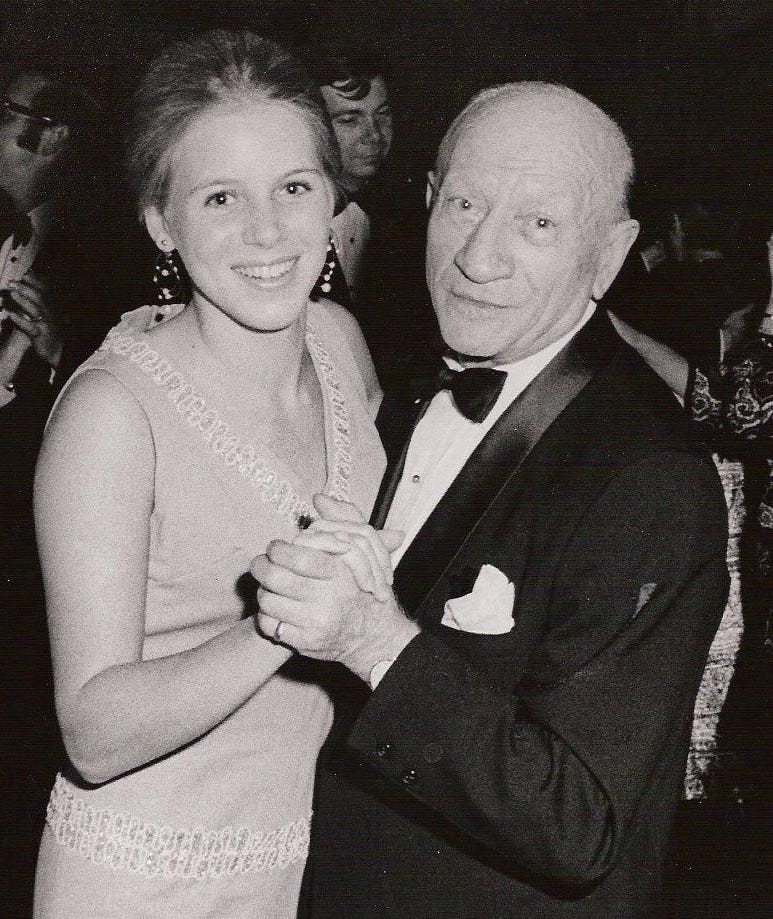
My grandfather, Bud, was an accomplished songwriter, originally of the Tin Pan Alley era, and he continued to write popular songs until his death in 1982. He was a widower for many years. He lived just outside New York City and we lived in New Jersey so visiting was easy.
In the late 1960’s he was invited to a semi-formal dance. I suspect the dance was put on by the Songwriters Hall of Fame, of which he was a member. Since he was a widower and did not have a girlfriend at the time, he invited my sister, Gwynneth, to be his date.
She was a college student at a nearby school. She had her hair done, wore a beautiful gown and looked smashing when she left the house.
She reported to me that as soon as they arrived, arm in arm, she was receiving ugly stares from many of the women and men.
Eventually one of Bud’s friends came over to say hello. Bud then introduced his granddaughter, Gwynneth, to the gentleman.
Upon hearing that, the man’s wife immediately came over with a smile to meet her. Gwynneth noticed that very quickly the entire hall had smiling faces, many of whom wanted to meet her.
It is not surprising that many thought Bud had a new girlfriend, decades younger than him. And it would be human nature that some people would approve and some would disapprove of the relationship of an elderly man and a much younger girlfriend.
How quickly those assumptions vanished upon hearing she was a family member and not a much younger girlfriend.
Gwynneth had not changed instantaneously, just the perception of who she was.
The Jester
I know my path, however circuitous, ultimately led me to retirement after a successful urology practice in Seattle. I have memories of my mindset during decades of schooling from elementary school through college, medical school, residency and then private practice. I think I know how I tried to carry myself in both work and play. My main question was not how I looked at myself, it was how did the world perceive me.
During my early schooling through high school, I was surrounded by many highly motivated intelligent kids. I learned very quickly that it would take an inordinate amount of work to keep up with them. It was much easier to stay under the radar as a jokester and not try to keep up with their level of schooling. I was a happy-go-lucky kid anyway.
I was constantly reminded by my mother that I was not working up to her perception of my intelligence. I felt that I could graduate with honors and stay under the “smart” radar. I was not interested in high honors, as that was too much work, and I did not want to take advanced placement courses.
When I graduated from high school with honors, my English teacher found me and said she was surprised that I had done so well. She made the comment that she thought she was the only one in the school who had given me an A. It felt as if she had given me a sympathy A, although I knew that I had done the work to receive it.
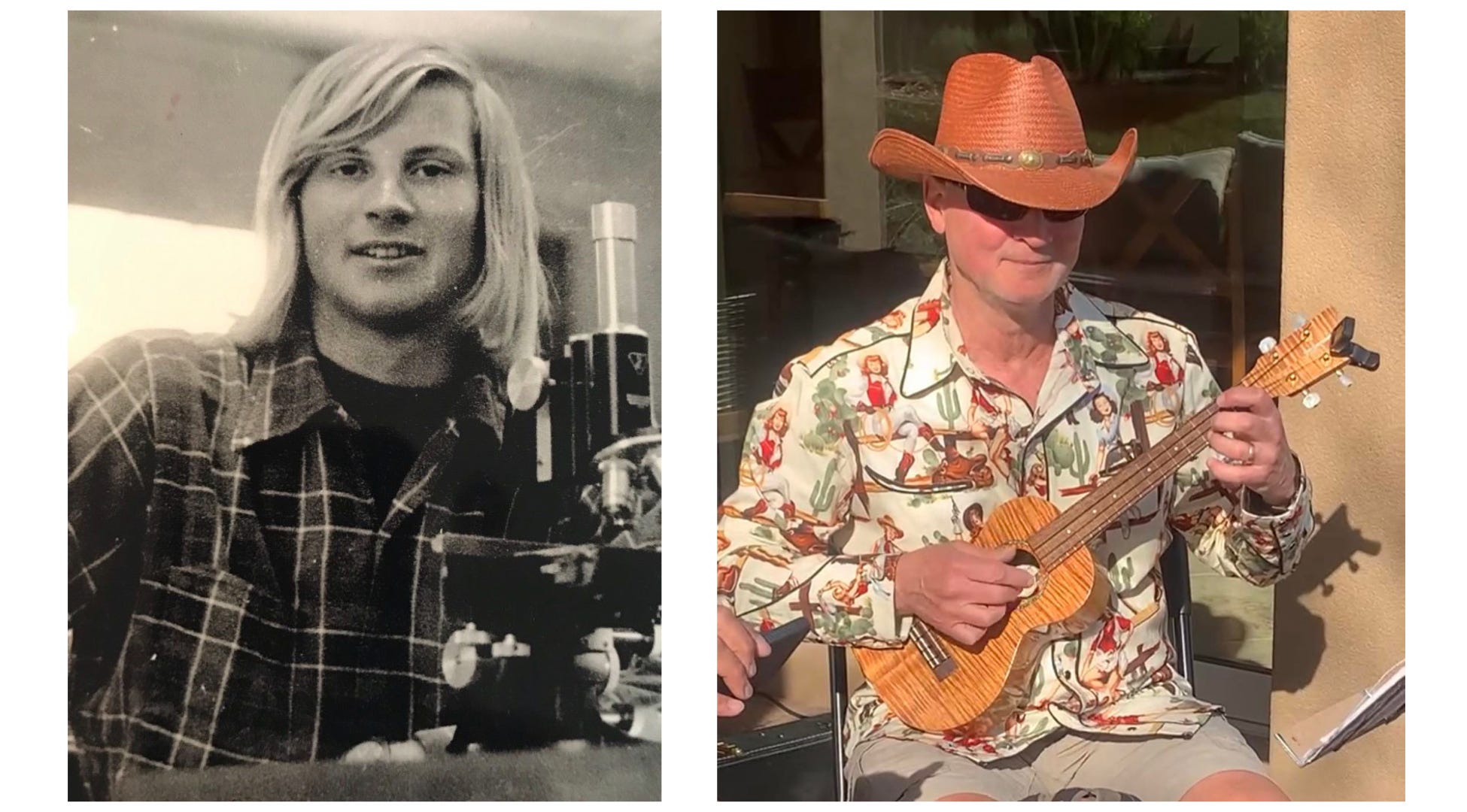
During college I continued to display the same under-the-radar, unserious student while trying to get the grades needed to be accepted into medical school. I thought I was showing the world I was a musical surfer dude, rather unserious.
I did become more serious from medical school on. But still, during the last fifteen years of private practice as a urologist, I wore Aloha shirts to work in Seattle daily, even in the winter.
A few months ago I was with my sister, Cathlin. We talked about our childhood and I asked her how she perceived me when we were kids.
I was shocked to hear that she said I was a jester at times and tightly focused at others. There was no middle ground.
The jester part did not surprise me. The focus part did.
When I went to my 50th college reunion, one of the very studious fraternity brothers said to me, “When we were in college, I thought you were just another ne’er-do-well.”
I have been lucky. A few weeks ago I was able to connect with and sit down for lunch with the Chairman of Urology from my residency days. We are now more than forty years removed from the time I trained under him.
During those years he was quiet and continuously evaluating the residents. It would have been highly unusual for a resident to receive praise. A good day simply meant that nothing bad was said about you.
I looked up to him even though our personalities were polar opposites. He held his emotions in check with subtle humor. I tried to cover my serious nature with jokes.
When I asked him what I was like under his tutelage, I expected a quiet zinger about being loud and brash.
Instead, he complimented my abilities in ways I did not expect.
When I told Karen this story, she asked why I had not been told those things forty years ago.
Maybe it was better this way. I don’t know.
But hearing this now, I have had to reevaluate how I perceived myself during those years and for decades afterwards.
For many years I kicked myself for not taking fuller advantage of my schooling. I did not work as hard academically as many of my classmates until I reached medical school. Looking back now, I wonder if that assessment is too simple.
Those years were spent sailing, surfing, teaching, traveling, working in a lumberyard, a delicatessen and behind the bar of a redneck tavern, making mistakes and meeting people whose lives were very different from my own. The broader life I lived outside the classroom may have helped me understand my patients and their lives in ways that could never have been learned from a textbook.
In the end, it was those connections, not just the medicine, that made me a better physician.
Over my lifetime I have met some clean-cut men who were hell raisers and some long-haired, heavily tattooed people who were gentle and charming. Diz was a nuclear industry expert hiding comfortably inside a fraternity boy. Gwynneth had not changed, only the perception of who she was.
Perhaps the lesson is not that we are poor judges of character. The lesson may be that most of us are far more complicated than the labels we place upon ourselves and others.
Can I be both serious and looney? Can I be both Bakari and Jester?
I think Cathlin had it right. Both versions are in the same person, sometimes visible at the same moment and sometimes one more apparent than the other.
And if that is true for me, it is probably true for most people I meet.
Very relatable topic, as time and people “move on”. I’m surprised by what I learn about well known family and friends, at their life celebrations. I value sharing deeper conversations, while enjoying simple past times. Still, at the end, I am reminded of life’s partial portraits. Nice that you are interested in rounding out your self portrait. 🥳 Bonny
Another very heartwarming piece Tom. Thank you